The past two months have been among the most dynamic since NewLimit’s founding. We’ve progressed our lead asset through a manufacturing scale-up, unlocked generalization across cell types in our AI systems, and restored function in old endothelial cells for the first time. Alongside these advances, we welcomed many new members to the team and closed our Series C financing.
Highlights by the numbers:
+4 leads that restore function in old hepatocytes
100X manufacturing scale of our lead therapeutic asset
3X data efficiency for in silico reprogramming in new cell types
+5 payloads that restore function in old endothelial cells
+19 payloads that make old hepatocytes look young, +43 in endothelial cells
People
We welcomed a record number of talented scientists, engineers, and operators to the team this summer.
Melissa Calton joined as our Head of Translation to expand our therapeutic pipeline and lead our Therapeutic teams. Melissa previously led multiple programs from preclinical through clinical proof-of-concept as a Vice President of Early Stage Product Development at 4D Molecular Therapeutics.
Prior to 4D, Melissa led preclinical development for small molecule programs at Verseon Therapeutics. She completed a Ph.D. in Pharmaceutical Sciences at the University of California, San Francisco and postdoctoral training at Stanford University.Tara Basu Trivedi joined as our Director of Operations to build out our core business functions. Tara previously held product and business roles in biotech at Inceptive, Enable Medicines, & PACT Pharma. She started her career as a software engineer at Google & X. Tara holds a Bachelor’s in Computational Biology from Brown alongside an MBA and Master’s in Engineering from Harvard University.
Lokesh Narsineni joined as a Principal Scientist to lead our Delivery Sciences group. Lokesh previously built the lipid nanoparticle team at Scribe Therapeutics. Lokesh earned a Ph.D. in Pharmaceutical Sciences at the University of Waterloo and postdoctoral training with Peter Cullis at the University of British Columbia.
Daniela Rojo joined as a Scientist on the Vascular team. Daniela was previously a K99 Fellow at Stanford University and completed her PhD at the University of Buenos Aires.
Saad Abdullah, Maitreyee Karmarkar, Warren Ko, and Xuefeng Sun joined our Research teams to discover and validate reprogramming payloads.
Accelerating metabolic recovery
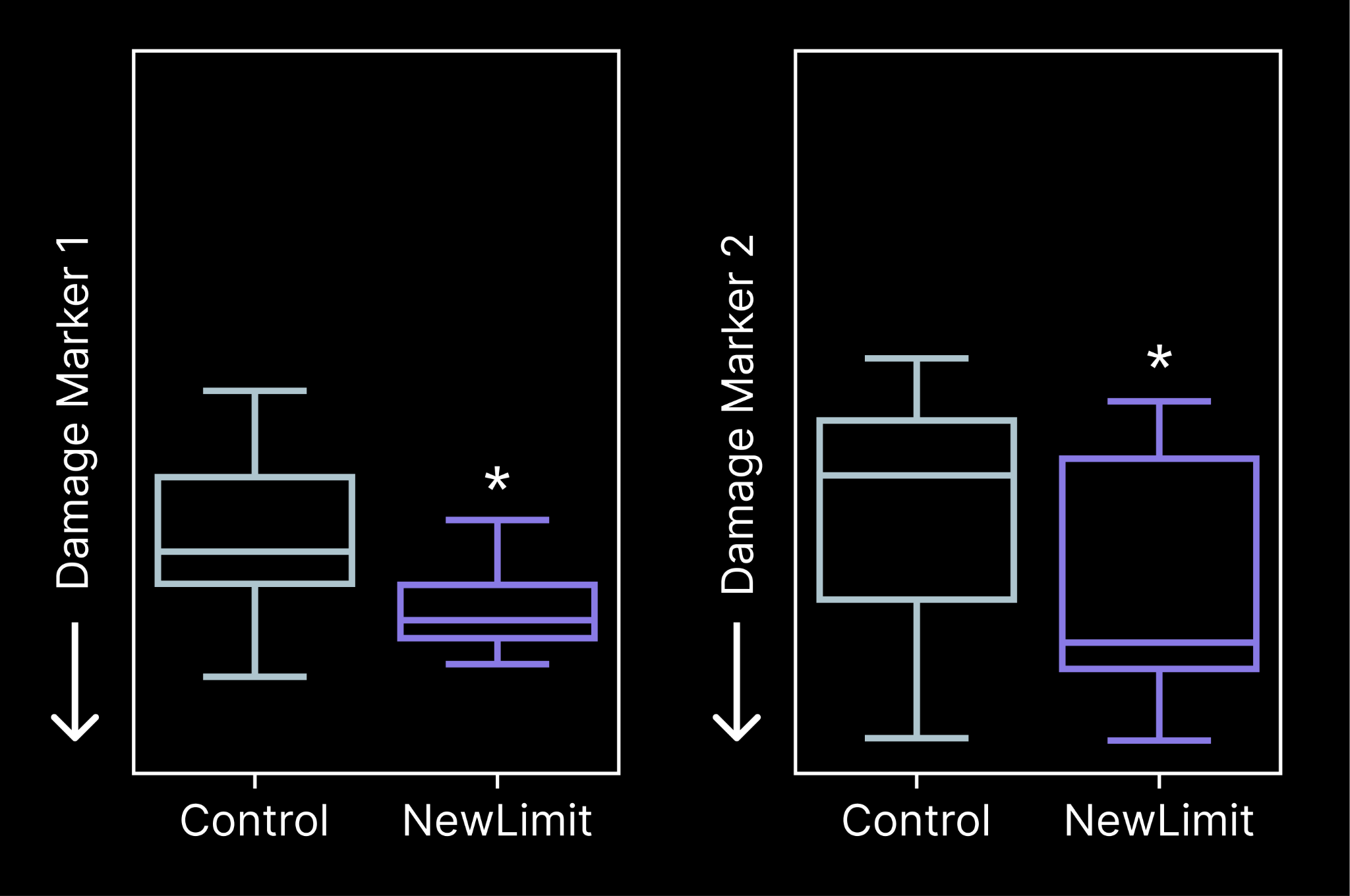
As part of our 2026 Progress Update, we shared additional data on our first candidate medicine. This candidate restores youthful function in hepatocytes of the liver, making them more resilient to damage and more effective at regenerating the tissue if damage occurs. We’ve also discovered benefits in metabolic function at the organismal level.
These benefits are large enough that they can be observed with the naked eye in animal behavior. One of our preclinical systems challenges animal livers through alcohol consumption, mirroring one of the avenues that leads to liver damage and disease in humans. We’ve observed that young animals show little behavioral change after consuming alcohol (below, left), while old animals experience a dramatic sedative effect and sleep for many hours (below, center). This phenomenon is just one demonstration of the profound impairment in liver metabolism that emerges with age.
By contrast, old animals treated with our reprogramming candidate exhibit behavior more similar to young animals after alcohol consumption (above, right). It’s rare in preclinical development that therapeutic effects can be observed so readily without any special instrumentation.
We’ve further explored the durability of these effects in later preclinical development. In recent studies, we’ve found that this resilience to damage from dietary insults can persist beyond the half-life of the candidate medicine.
We’re excited to progress this asset through the final preclinical development stages to enable our first-in-human studies.
Crafting medicines at scale
Our first medicine is bound for the clinic next year. Before we can run clinical trials or pivotal nonclinical safety studies, we first need to manufacture our medicine at a far larger scale than we have previously.
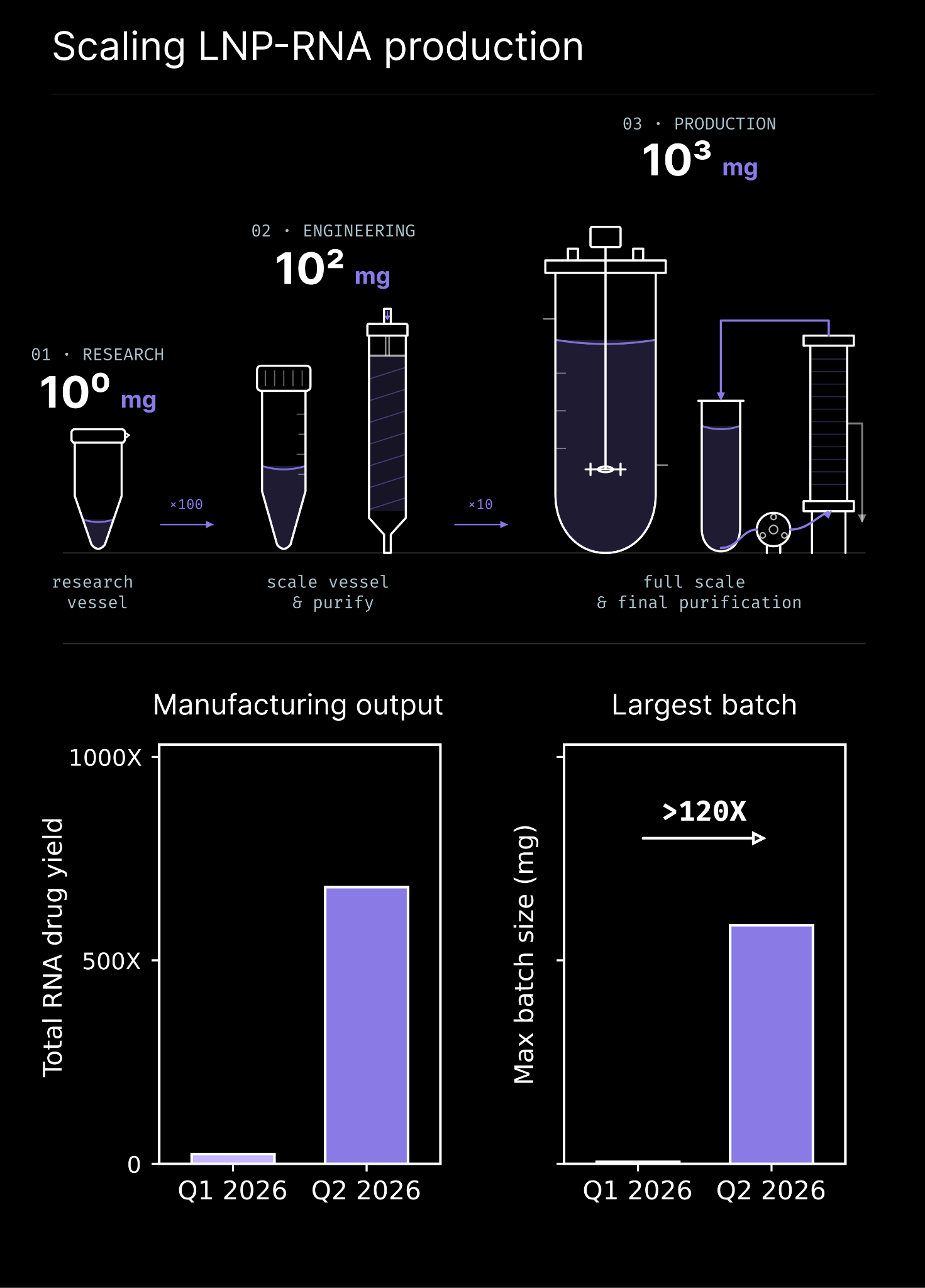
Early experiments to validate the efficacy of a reprogramming medicine in human cells or animals might use <1 milligram (<10-3 grams). Pivotal toxicology studies require >100 milligrams, and our clinical trial will require >1000 milligrams. Manufacturing at these >100X and >1000X scales requires a far more sophisticated process.
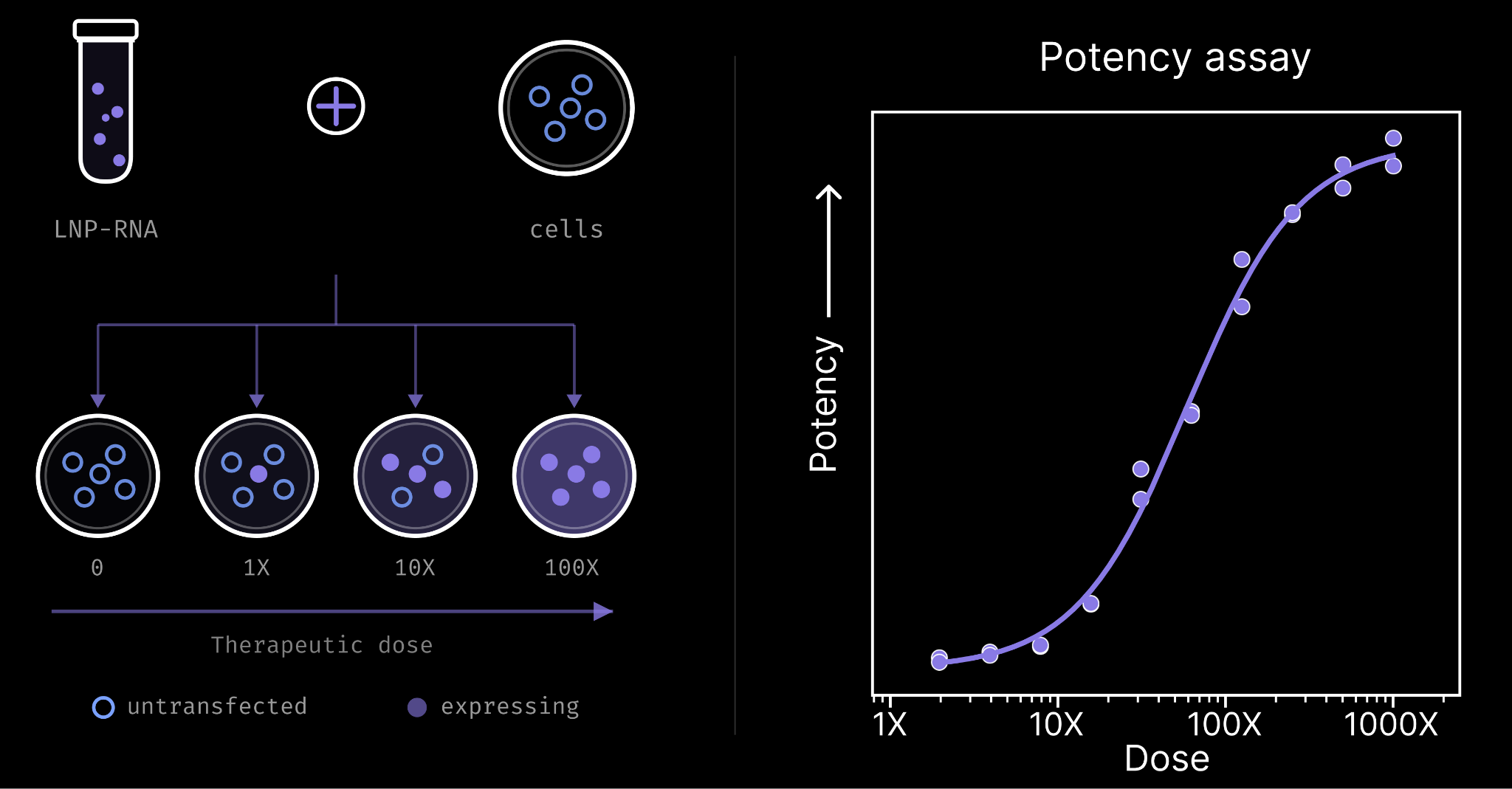
Not only do we need to increase the quantity of medicine we need to manufacture, we also need to produce higher quality batches. Even our final nonclinical studies need to use material that is of the same quality we would employ in a trial. To check for quality, we first measure the biochemical properties of our medicine like the size of the lipid particles and identity of the RNA, akin to unit tests. We then test the actual function of the medicine by delivering it to a cell culture system and measuring the downstream effects, providing a final integration test.
We’ve worked with multiple partners and have now produced batches >120X larger than any before, sufficient to enable pivotal nonclinical studies. Our team also successfully built the first assays to ever measure the potency of a reprogramming medicine to our knowledge. These manufacturing improvements bring us a step closer to the clinic.
Generalizing across developmental lineages
The first step in the invention of a reprogramming medicine is discovering a group of transcription factors – a payload – that restores youthful function in old cells. We’ve built the world’s frontier experimental system to test reprogramming payloads in the real world. Nonetheless, we’ll never be able to test all possible combinations of TFs. There are more than 1016 plausible combinations, and we need to carefully allocate our budget of experiments across this space to make discoveries.
We’ve built an AI system called Ambrosia atop this experimental data to help prioritize our real world verification efforts. Our system performs in silico reprogramming experiments, predicting the effect of reprogramming on the phenotype and function of an old cell for any set of transcription factors. Once trained, we can use the system to design reprogramming payloads to restore youthful function, then verify their performance experimentally.
Historically, we’ve trained our AI system independently across our therapeutic programs focused on hepatocytes, endothelial cells, and T cells. This is a task- or lineage-specific approach to building models, treating each program as its own unique problem. Given this training paradigm, our models were naïve to the data we’d generated for one program as we designed experiments for another.
We hypothesized that this was suboptimal. It’s likely that there is a large degree of mutual information for reprogramming effects across cell types. The degree of mutual information might be proportional to the similarity of developmental lineages between the two cell types. The lessons we learn in one program could likely transfer to another.
This summer, we introduced the first mechanisms for our models to generalize across cell types. In this regime, our models access data from multiple cell types during the prediction and design process for each of our programs. We’ve discovered that this generalization approach improves in silico reprogramming performance. In one example, we found that our generalized model matched the performance of a lineage-specific model to predict endothelial cell reprogramming effects using 3X less endothelial cell data.
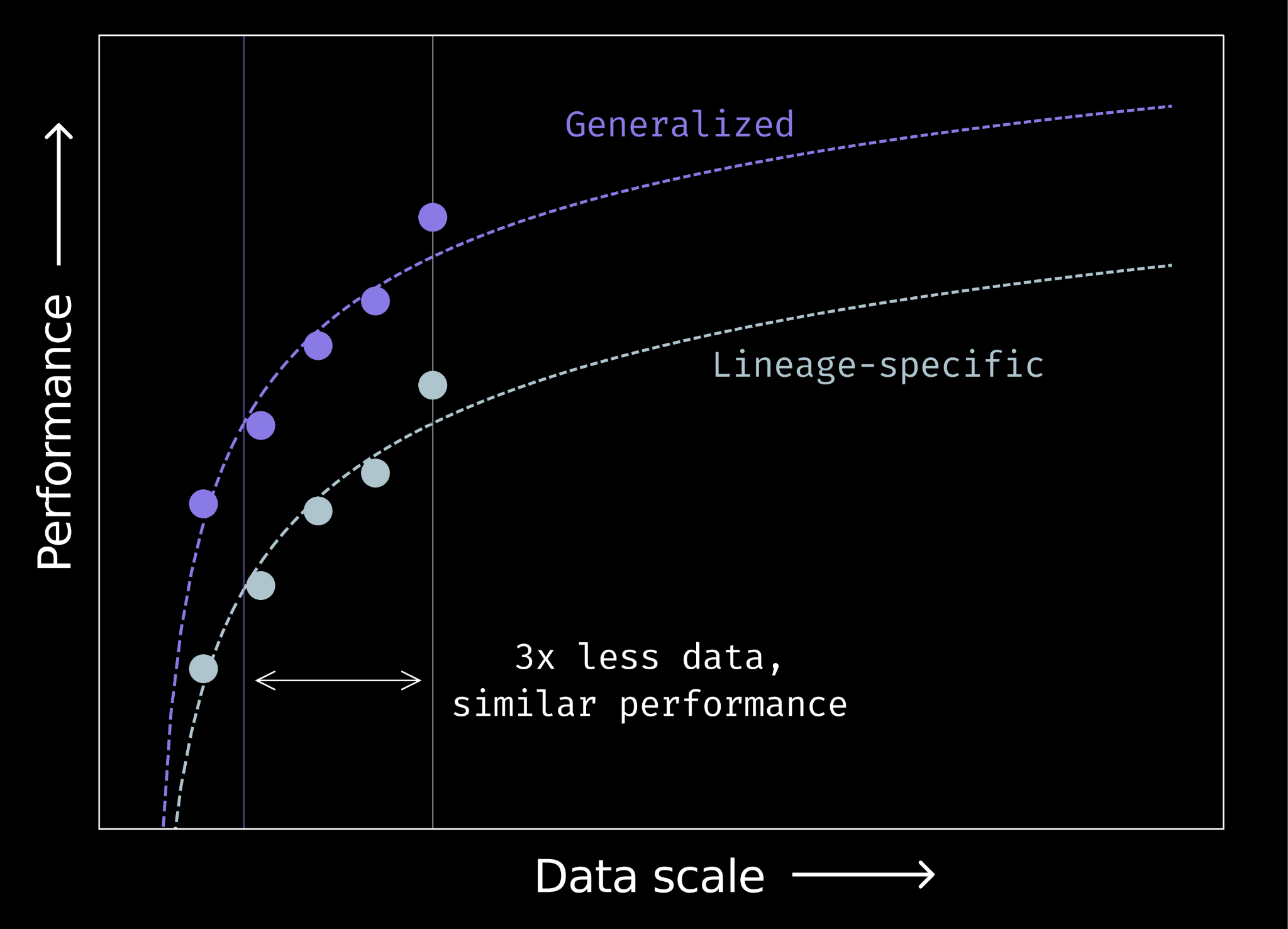
These results are early, but have important implications. As our models generalize more effectively, we can train performant AI systems in a new cell type with less real world experimental data. This decreases the cost of launching a new therapeutic program, and allows us to explore more applications of reprogramming technology per dollar invested.
Restoring endothelial cell function
We launched our Vascular program to restore youthful function in endothelial cells just months ago. If successful, we believe a more youthful vascular system can preserve health in the kidney, cardiovascular system, and promote healthy cognition. In May, we discovered the first reprogramming payloads that make endothelial cells look and act young.
Before we could discover these payloads, we needed to build tools to measure their effects. We started by creating a suite of assays to measure the functional defects that arise in old endothelial cells. In the body, endothelial cells lose angiogenic (Greek for “blood vessel forming”) potential and fail to maintain a healthy vascular network. One of the ex vivo assays we built captured this defect in human cells, recapitulating that old cells are less regenerative.
With this tool in hand, our team paired it with our pooled screening system to test thousands of reprogramming payloads in parallel. In a series of iterative experiments, we discovered a set of 5 payloads that both restore youthful gene expression in old endothelial cells and rescue regenerative potential. We also found that pro-youthful effects were correlated across gene expression and functional measures, confirming that our cell age prediction models are capturing relevant features of endothelial aging biology.
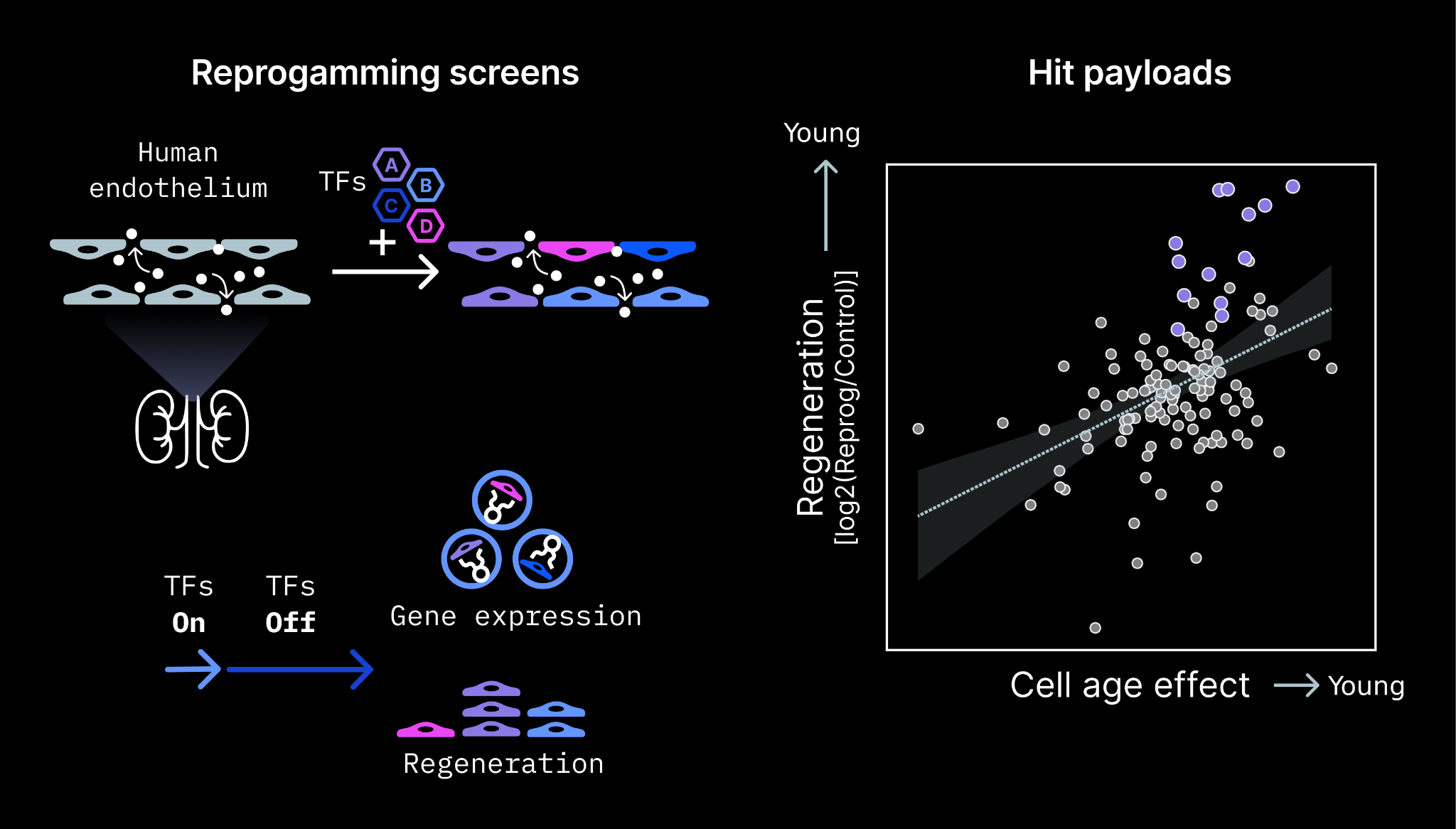
This represents our most rapid timeline from program launch to functional hit discovery yet. Combining the generality of our molecular tools with our newly general AI systems, we believe future programs will progress even more rapidly.
Elsewhere
We shared the NewLimit story through a few additional outlets over the past few months. Many of these discussions arose from our Series C financing, but we also dove into our first therapeutic asset, underlying technology, and clinical development plans.
Wall Street Journal: our Series C financing, first medicine, and upcoming trial
Bain Capital podcast: NewLimit’s founding, therapeutic approach, and initial medicines
Endpoints, Fierce Biotech, STAT News: our first medicine, upcoming trial, and Series C financing
Join the NewLimit team
NewLimit is transitioning from a pure Research organization into an integrated Research & Development firm. We’re recruiting across several departments as a result, including Clinical Development, Technical Operations, and our Vascular program. Please reach out if you or a colleague might be a good fit!